
To Be Close To You
Finding That Special Something With Someone

Another Valentine’s Day has passed, and with it the particular kind of happiness or angst or grief that the holiday may promote. It’s a pretty sure bet that, being humans, we’ll go on caring about intimacy — seeking it or trying to maintain or deepen it; avoiding it or wanting to squelch a memory of it — for the entire rest of the year.

Most of us have seen a plethora of hearts over the past week or so; this one was displayed right in the center of our small town. I enjoyed mailing a card with a picture of a fully labeled actual heart to my becoming-a-cardiologist son. As we move on into the rest of February, what remains to wonder is whether we’re content with the quality of intimacy that we have in our lives, and perhaps whether there’s anything within our power to do to help nurture it.
What Wears Well?
Although mall stores are in decline now, we’re familiar with signs like this.

OK, sure, this place offers “intimates” — used as a noun — of a certain kind, in a wide array of colors and shapes. They serve a purpose, but they’re not to be confused with the kind of “intimacy” that is not anything you wear, the kind that is more like a spark between two people just discovering one another…

or maybe a long-smoldering fire still giving off plenty of heat and comfort..:

Now both of those couples are clearly, in their different ways, leaning in: each individual is to some degree merging with another — rapturously, with a sense of everything being new, or more serenely, with years of experience accumulated.
Turning to Fiction for Understanding
Ever since I first encountered the novels of the Irish writer Sally Rooney, I tend to go back to her for depictions of how two individuals can portray a kaleidoscope of emotions and reactions as they are drawn to one another, but with complications. She’s so darn good at getting inside people’s hearts. Here’s the cover of her second book, published by Hogarth (London, New York) in 2018.
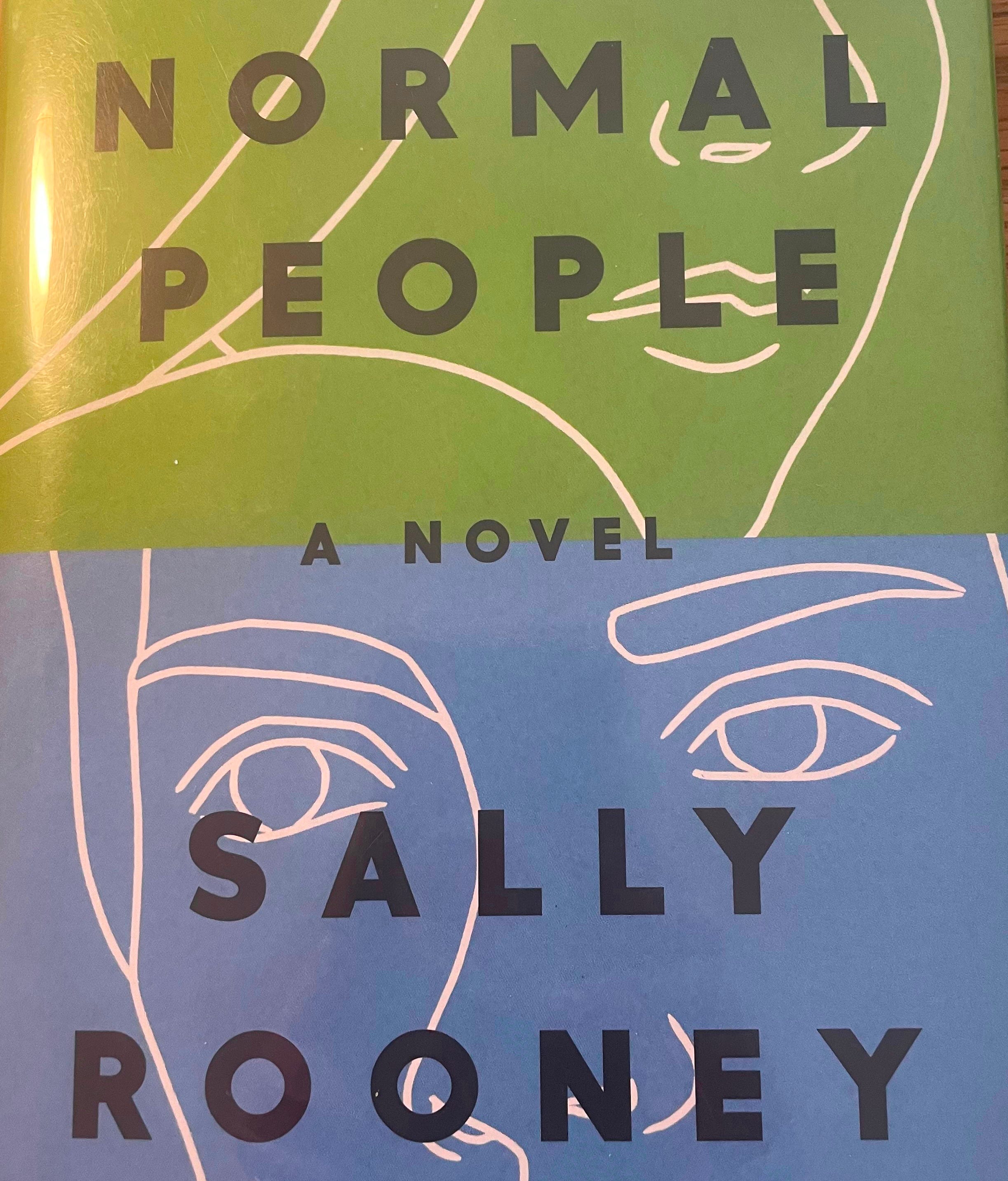
In the opening pages, when Connell sees Marianne outside of school, a place where they never talk because he’s in a friend group that she can’t access, we get this description:
When he talks to Marianne he has a sense of total privacy between them. He could tell her anything about himself, even weird things, and she would never repeat them, he knows that. Being alone with her is like opening a door away from normal life and then closing it behind him. (p.6-7)
And then later, right after Connell tells her he loves her (not much of a spoiler, I hope) this is how Rooney gives us Marianne’s reaction:
She has never believed herself fit to be loved by any person. But now she has a new life, of which this is the first moment, and even after many years have passed she will still think: Yes, that was it, the beginning of my life. (p.46)
In an interview she did with Hazlitt Magazine back in 2019, Rooney talked about what fascinates her most about intimacy, and it has to do with both religion and philosophy:
It seems like most societies have evolved a concept of the loss of self, or the giving away of self, or selflessness. Certainly, very central in Christian thought, in Buddhist thought as well. So, I think there’s something to it. There’s a reason why we keep returning to this idea philosophically across societies and in different cultural circumstances. And I think one of the ways that we experience it most readily, now, in our current cultural setup, is through intimacy with others. That opens up the possibility that we are giving away our sense of self or putting our own best interests behind the best interests of another person.
I like her turn of phrase here, with “our current cultural setup.” She knows, of course, that there’s nothing particularly “current” about intimacy in relationships; we haven’t discovered it for the first time, that’s for sure. Maybe she means that the “cultural setup” we now find ourselves in doesn’t promote a whole lot of selflessness in ways other than through the intimacy we experience with certain key individuals.
Or Maybe to Robots
Yesterday’s New York Times featured an amazing story on the front page about a Brave New World kind of intimacy — only one half human. The article has the beguiling title of “She’s 85, and Her Roommate Is a Robot.” You can read it all right here. An elderly woman who wanted to be able to stay alone in her home in Washington (the state) without many far-flung family members worrying about her safety acquired, thanks to an Israeli company called “Intuition Robotics,” a robot companion called “ElliQ.” This robot not only responds to things that it’s asked to do but also, after getting to know the flesh-and-blood person, begins to suggest activities. The two of them (did I just say that?) are currently writing a memoir together.
Clearly, the arrangement is working out beautifully. Not only have some of Jan Worrell’s key health indicators improved, but she also sees the robot as a kind of confidante and wants to invite her friends over to get acquainted. Here is what one of the company’s founders says about ElliQ now:
‘The intensity of the relationship is much deeper than we ever thought,’ he told the investors. ‘There’s real intimacy happening. It’s kind of mind-blowing.’

Mind-blowing, indeed.
I won’t be lining up to say, all in a huff, that this is a ridiculous trend and should be stopped before we lose all sense of what “real” intimacy is. That Jan Worrell should really go live in a new place with other people nearby. Maybe, in this case and in many others where technology is so rapidly changing and offering indisputable help, we need to heed Isaiah 54:2-7:
Enlarge the place of thy tent, and let them stretch forth the curtains of thine habitations: spare not, lengthen thy cords, and strengthen thy stakes;
What do you think, dear reader? Give me some intimation, if you please.